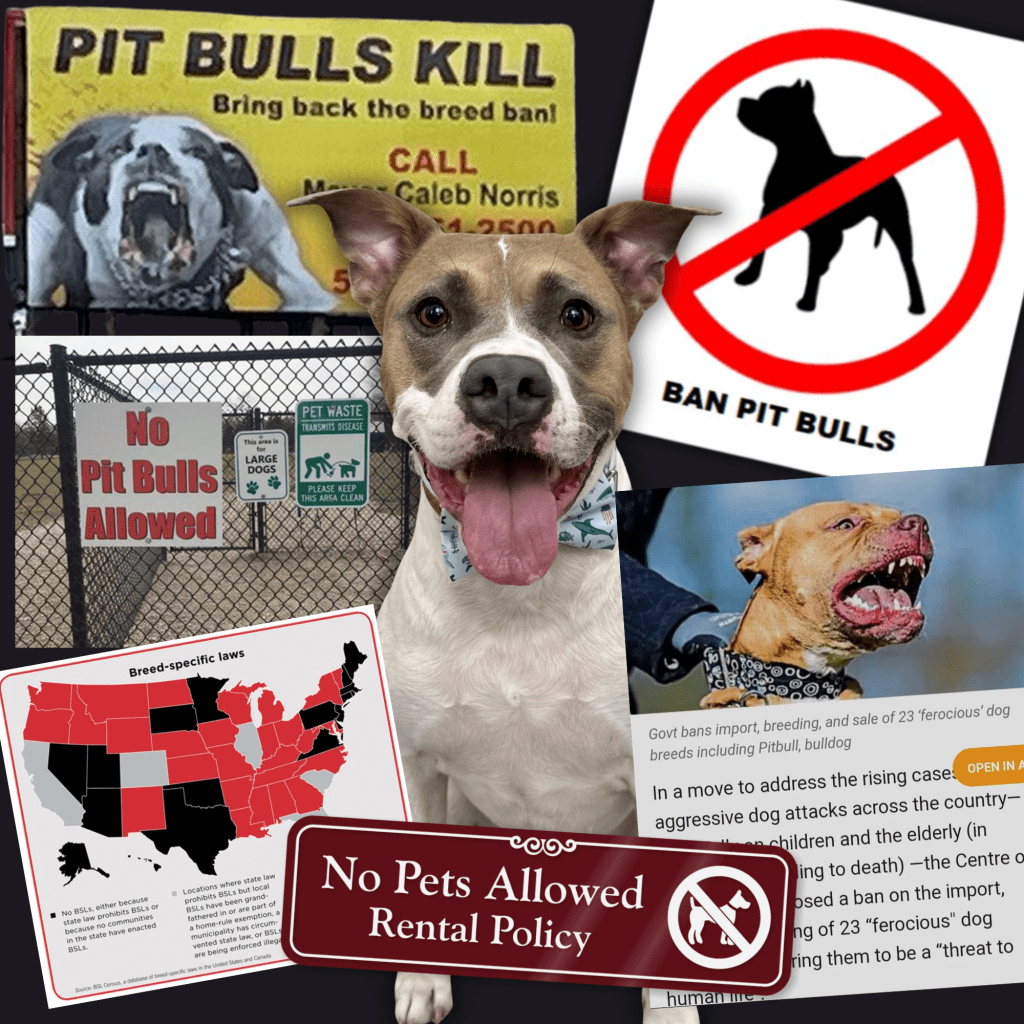
When people talk about “pit bulls,” the conversation is rarely neutral.
These dogs are often described as dangerous, aggressive, or unpredictable. But those perceptions are not formed in isolation—and they are not based solely on behavior.
They are shaped by history, media, and social context.
In fact, many advocates and researchers argue that the stigma surrounding bully breeds is rooted, at least in part, in cultural and racial bias—specifically, how these dogs became associated with marginalized communities over time.
A Note on Terminology
The term “pit bull” is often used as a catch-all label, but that usage is inaccurate. A true pit bull refers specifically to the American Pit Bull Terrier.
In practice, many dogs labeled as “pit bulls” are actually other bully breeds or mixed-breed dogs with similar physical traits. Because visual breed identification is often unreliable, mislabeling is common across shelters, media reports, and housing policies.
For this reason, this article uses the terms “bully breeds” or “bully-type dogs,” while referencing “pit bull” only when discussing public perception, policy, or media narratives.
How Bully Breeds Became Associated With Marginalized Communities
The stigma surrounding bully breeds did not emerge randomly—it developed alongside broader social and cultural narratives.
Beginning in the late 20th century, these dogs became increasingly associated with urban environments, crime, and aggression. Media portrayals often depicted them as “guard dogs” or symbols of toughness, frequently alongside images tied to gangs or violence.
Importantly, these portrayals often overlapped with stereotypes about low-income and predominantly Black communities, who have historically been overrepresented in discussions about poverty due to systemic inequality.
Over time, this created a pattern:
- Bully breeds were associated with certain environments
- Those environments were already stigmatized
- The dogs themselves became symbols of those same stereotypes
Some researchers suggest that this reflects a broader phenomenon in which bias toward people can extend to the animals associated with them.
How This Stigma Creates a Cycle
The stigma surrounding bully breeds does not just affect perception—it shapes outcomes in ways that reinforce the same narrative.
Because these dogs are more likely to be labeled as dangerous or restricted by housing policies, they are also more likely to be surrendered to shelters or denied stable housing.
This contributes to their overrepresentation in shelter populations.
At the same time, access to pet acquisition is not equal. Adopting from a shelter is typically more financially accessible, while purchasing from a breeder can involve significantly higher upfront costs.
This creates a reinforcing cycle:
- Bully-type dogs are more likely to end up in shelters
- Shelters are more accessible to lower-income individuals and families
- Those same communities—already associated with these dogs—adopt them more frequently
- The association between the dogs and those communities is reinforced
Over time, this loop strengthens the original stigma, even though it is driven by structural factors like cost, access, and housing restrictions—not inherent traits of the dogs or the people.
How Bias Shows Up in Animal Welfare Systems
These patterns are reflected in how bully breeds are treated across animal welfare systems.
Breed-Specific Legislation (BSL)
Many cities and housing providers restrict or ban bully-type dogs, often based on perception rather than consistent scientific evidence.
Shelter Overrepresentation
Bully-type dogs are consistently overrepresented in shelters and often experience longer stays and lower adoption rates.
Perception vs. Behavior
Major veterinary organizations emphasize that behavior is shaped more by environment, training, and responsible ownership than by breed alone.
How the Narrative Can Shift
Addressing this issue requires both awareness and structural change.
Policy and Advocacy
- Moving away from breed-specific legislation
- Promoting behavior-based assessments
- Expanding access to pet-inclusive housing
Public Education
- Sharing accurate information about dog behavior
- Challenging assumptions about breed
- Highlighting real experiences with bully-type dogs
Final Thoughts
The stigma surrounding bully breeds is often framed as a question of behavior.
But in reality, it is also a question of perception—shaped by history, media, and broader social bias.
Perception influences policy.
Policy influences outcomes.
And those outcomes determine which dogs are given the opportunity to stay in homes, be adopted, or remain in overcrowded shelters.
Understanding the roots of that perception is a necessary step toward creating a more equitable approach to animal welfare.
Sources
- DNA Studies Reveal That Shelter Workers Often Mislabel Dogs as Pit Bulls — University of Florida College of Veterinary Medicine
https://www.vetmed.ufl.edu/2016/02/17/dna-studies-reveal-that-shelter-workers-often-mislabel-dogs-as-pit-bulls/ - The Racialization of Pit Bulls: What Dogs Can Teach Us About Racial Politics — PLOS ONE
https://pmc.ncbi.nlm.nih.gov/articles/PMC11213322/ - Why Breed-Specific Legislation Is Not the Answer — American Veterinary Medical Association
https://www.avma.org/resources-tools/pet-owners/dog-bite-prevention/why-breed-specific-legislation-not-answer - U.S. Animal Shelter Statistics — ASPCA
https://www.aspca.org/helping-shelters-people-pets/us-animal-shelter-statistics - How Much Does It Cost to Adopt a Shelter Pet? — Shelter Animals Count
http://shelteranimalscount.org/yahoo-how-much-does-it-cost-to-adopt-a-shelter-pet/ - Pit Bull Label May Triple Length of Stay in Dog Shelters — PLOS ONE (via ScienceDaily)
https://www.sciencedaily.com/releases/2016/03/160323151835.htm - Dog Bite Risk and Prevention: The Role of Breed — American Veterinary Medical Association
https://www.avma.org/sites/default/files/resources/dog_bite_risk_and_prevention_bgnd.pdf
 Social Pup Studio
Leave a comment